

PSA For: Asthmatic Boricuas
PSA
PSA FOR ASTHMATIC BORICUAS
A Housing and Health Wake-Up Call for Public Housing Residents
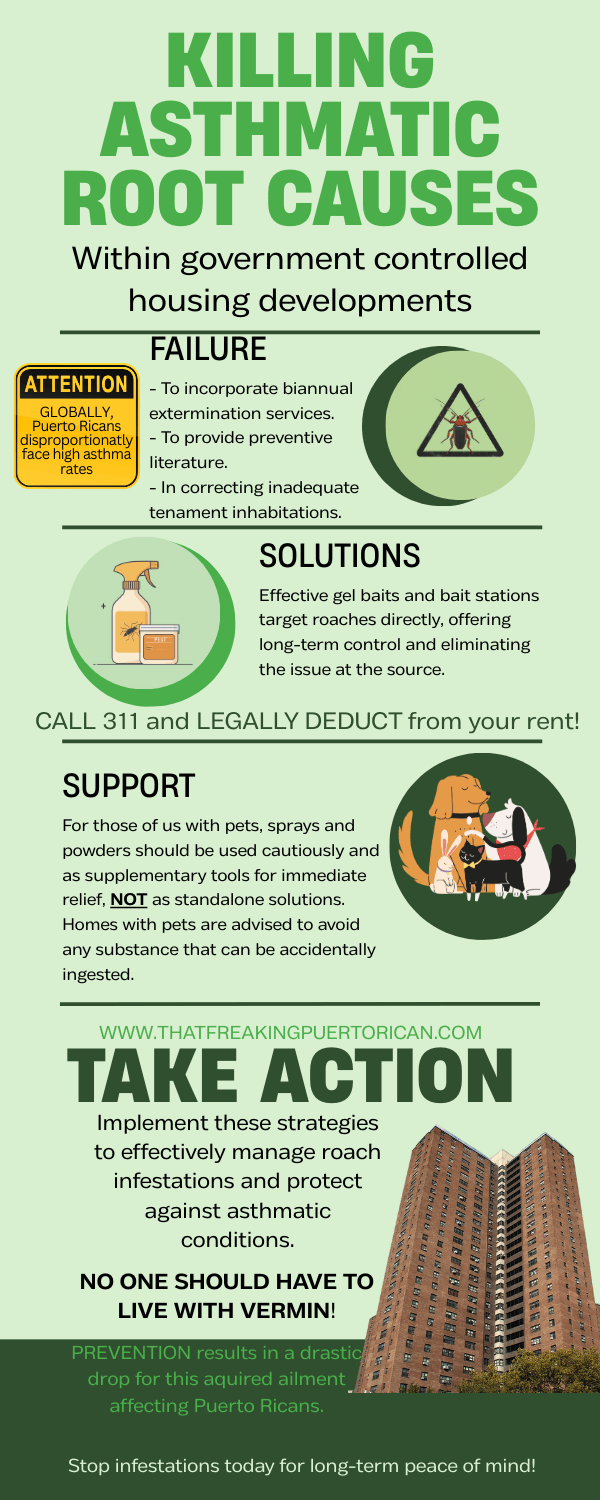
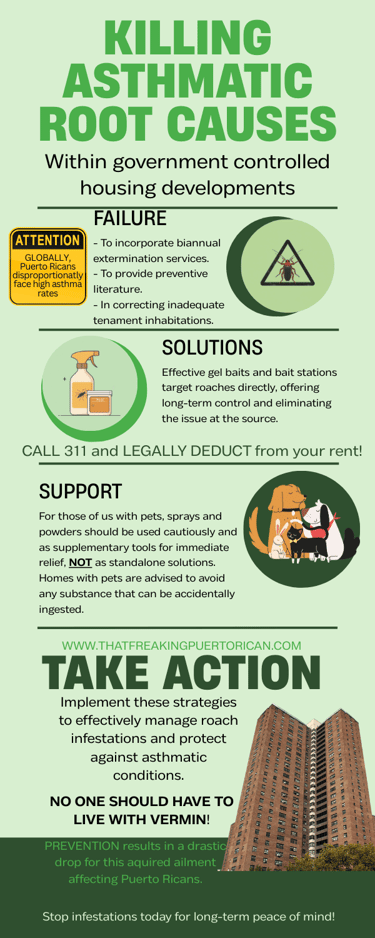
Asthma is not just a medical issue in our communities. It is a housing issue. For Puerto Ricans in New York City, especially those living in public housing and older tenements, asthma rates remain alarmingly high. This is not coincidence. One of the most overlooked contributors is cockroach infestation and the structural conditions that allow it to persist.
Cockroaches are not just unpleasant pests. They release powerful allergens from their bodies and feces. These microscopic particles become airborne, settle into dust, bedding, and ventilation systems, and are easily inhaled. For people with asthma, especially children and elders, cockroach allergens are a well-documented trigger for attacks, chronic inflammation, emergency room visits, and long-term lung damage.
Here is the hard truth. You can keep your apartment spotless and still suffer the consequences. In public housing and shared buildings, roaches migrate freely through walls, pipes, electrical chases, hallways, trash rooms, and basements. Structural vulnerabilities combined with inconsistent or inadequate pest management create perfect breeding grounds. One clean unit cannot defend itself against an infested building.
Cockroaches are also far more resilient and adaptive than most people realize. They can learn and remember multiple escape routes, make rapid decisions, and adapt quickly to threats. They can survive for about a week without their head because they do not rely on lungs or blood pressure the way humans do. They breathe through spiracles along their bodies. They can live for roughly a month without food as long as they have water. They can hold their breath for up to 45 minutes and survive underwater for extended periods. They routinely pick up bacteria such as E. coli and Salmonella from sewers and decaying matter, spreading contamination across food surfaces and living spaces.
This matters because insect intelligence and adaptability make half-measures ineffective. Roaches respond to environmental pressure. If extermination is inconsistent, poorly coordinated, or limited to individual units, infestations rebound fast.
Termites and other social insects offer a useful comparison. Like ants and bees, they build complex structures and operate through sophisticated social organization. Insect intelligence is often defined by social learning and communication, problem solving, memory, adaptability, and cognitive flexibility. Cockroaches check many of these boxes. They are survivors by design.
Housing conditions are a root cause, not a side issue.
Now add the human reality. Puerto Ricans in NYC and across the United States have some of the highest asthma rates of any Hispanic subgroup, often exceeding national averages by a wide margin. Neighborhoods like the Bronx and East Harlem are especially affected. The causes are layered. Genetics play a role, but environment is decisive. Dust mites, mold, poor ventilation, pollution, and yes, cockroach allergens, combine with socioeconomic stressors to create a perfect storm. Some NYCHA tenants, and NYC tenants more broadly, may legally deduct extermination costs from rent under what is known as repair and deduct. But this is risky and procedural. It requires written notice to the landlord, extensive documentation, a 311 inspection, reasonable time for the landlord to act, and readiness to defend the action in Housing Court. Tenants who attempt this alone are often accused of being in breach and face retaliation. Consulting a tenant lawyer first is critical.
This strategy only has real power when tenants move together.
One or two households acting alone are vulnerable. Entire buildings or tenant associations acting in unison change the balance. Coordinated complaints, inspections, legal action, and media pressure force systemic remediation instead of cosmetic fixes. Housing-wide extermination, sealing of structural entry points, trash management reform, and accountability are the only approaches that work long term.
So, mi gente, if we truly want to reverse the asthma crisis in our community, we have to stop treating it as an individual health failure and start confronting it as a collective housing injustice. You do not inhale asthma in a vacuum. You inhale it through walls, vents, dust, and neglect. Tackle the tenements. Tackle the structures. Tackle the systems that allow this to continue.
Our lungs depend on it