
Mass-Produced Originals
CULTURAL
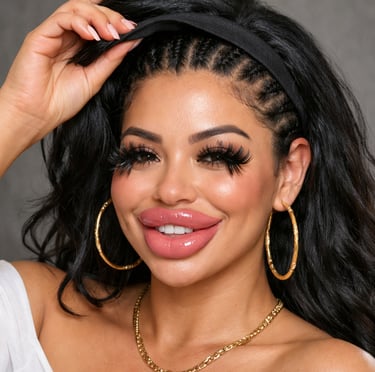
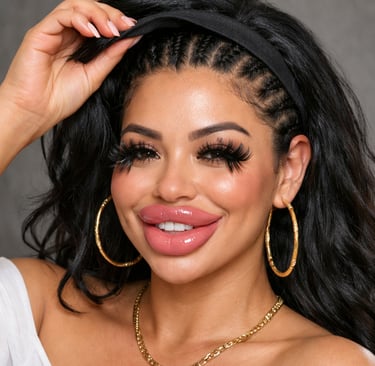
I have a ginormous problem with Hispanic women—especially Boricuas—rocking full-on wigs over an entire head of long, healthy hair braided down like cocolas. Since when? When did this become the uniform?
Let’s cut the bullshit right now: this is not about alopecia. Most women don’t suffer from it, and women in the hood damn sure aren’t walking around with mysterious mass hair loss epidemics. Yet here we are, with the babyhair wigs, the feathery lashes, all sitting on bodies wrapped in a Frankenstein mix of augmentations, deductions, lifts and injections wrapped in high-end logos and knockoffs like a walking Insta ad for an “aspirational poverty facade, i.e., be the best-looking, poorest mother fucker in the room.”
As a 90s teen, I remember very clearly why Puerto Rican women were that girl. We were sought out for the exact opposite reason. We didn’t need the extra layers, and disguises. We were already killing it—bare, loud, sensual, confident, and unfiltered. And no, that memory isn’t sentimentality poisoning my brain. It’s documented reality. This shift didn’t happen by accident, either. It happened because somewhere along the way, Boricuas have tweaked themselves to gravitate towards the Kardashianesque modified physique.
But, as I said, we were all that and then some. That memory isn’t nostalgia-fueled fiction. It’s fact-based. The difference is that now, for reasons that deserve real interrogation, we are seemingly chasing imitations of ourselves.
And let me say this plainly, since nobody wants to touch it: as Boricuas, our people have more than earned the right to speak out against conforming just to be accepted as neighboring peoples to the tribulations of POCs in urban settings across the U.S. We’ve lived the grind. We’ve absorbed the struggle. We don’t need to costume ourselves in someone else’s trauma or aesthetic to validate our place in it. Survival doesn’t require a wig install.
Is this about inclusivity? Acceptance? Visibility in a digital era where beauty has been stripped of soul and repackaged as content? Because let’s not pretend otherwise—beauty is no longer local, cultural, or organic. It’s algorithmic. Engineered for ring lights, front-facing cameras, and monetization. Subtle doesn’t trend. Loud does. Authentic doesn’t sell. Excess does.
Wigs. Lashes. Inflated lips. Exaggerated curves. None of this is about hiding flaws. It’s about broadcasting a look that signals “expensive,” “clickable,” “sexual,” and “market-ready.” And here’s the scam: that look is being sold back to women who were the original source material. Read that again. The culture vultured itself and was resold to us as cheap replicas.
This is the part nobody wants to say out loud. Boricua women were never trend followers. Trends followed us. Our confidence wasn’t learned on YouTube. Our curves weren’t injected. Our sensuality wasn’t curated for engagement metrics. It was born in kitchens, block parties, schoolyards, and survival. It came from resilience forged in places that demanded it—without filters, without permission, without costumes.
So yeah. I’m not confused or offended. Pissed is more like it. And I’m asking the question out loud because somebody has to and it's not about "when" as opposed to WHY this happened in the first place.
What Kardashian culture did wasn’t invent anything new. It sanitized it, packaged it, trademarked it, and sold it as aspirational. And some people bought the packaging instead of remembering they were already the blueprint.
Now, let’s be fair. Not every woman wearing a wig is insecure. For many, it’s a switch. A choice. Armor, in a way. A costume/disguise you can take off when you feel like it. That’s not the issue. The issue is when effortlessness becomes performance. When women who never needed approval start dressing for it anyway.
Puerto Rican women never needed permission to take up space. But social media made validation profitable. And when approval becomes currency, even the most self-assured cultures feel the pull. So no, this isn’t an anti-wig rant. It’s a reminder. We were never the imitators. We were the live models society mimics. The irony is that while people chase a manufactured version of beauty, the original has been right here the whole time.
C’mon, Boricuas. Remember who you are.