
BREAKING AWAY
RETIRING TERMINOLOGIES THAT ERASE OUR TRUE HISPANIC IDENTITY
INFORMATIVE

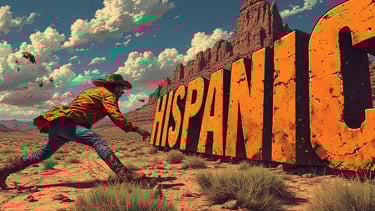
A Historically Rooted Call for Puerto Ricans to Reclaim Their Name
Identity didn’t just fall out of the sky. It’s shaped by history, empire, migration, language, culture, and bloodlines. And yet, Puerto Ricans keep getting wrapped into vague, inaccurate, politically constructed labels like “Latino” or “LatinX” — terms that flatten us into a generalized demographic blob with no historical specification.
Let’s make this clear:
Puerto Ricans are Boricuas. Boricuas are Hispanic. And the “Latino” label was never historically meant for us.
THE ORIGINS OF “HISPANIC” VS. “LATINO”: WHAT THE RECORD SAYS
Historically, the term Hispanic comes from Hispania, the Roman province that encompassed modern-day Spain and Portugal. “Hispanic” refers to peoples and cultures tied to the Spanish-speaking world, shaped directly by the legacy of the Spanish Empire.
The term Latino, however, didn’t emerge from ancient Rome or the Iberian Peninsula. It was invented by 19th-century French imperialists.
In the 1850s, Napoleon III pushed the phrase “Amérique latine” to justify French expansion into Mexico and the Caribbean.
It was a political strategy — Napoleon III thought he was slick by trying a branding effort to group French, Spanish, and Portuguese colonies together so France could claim “cultural kinship” and expand influence.
To reiterate: Puerto Rico, under Spanish rule from 1493 to 1898, had no connection to the French colonial identity project that birthed “Latin America.”
So from the beginning, Hispanic = accurate.
Latino = borrowed, external, politically manufactured.
THE SPANISH ROOT OF PUERTO RICAN IDENTITY
Let’s talk lineage and cultural inheritance.
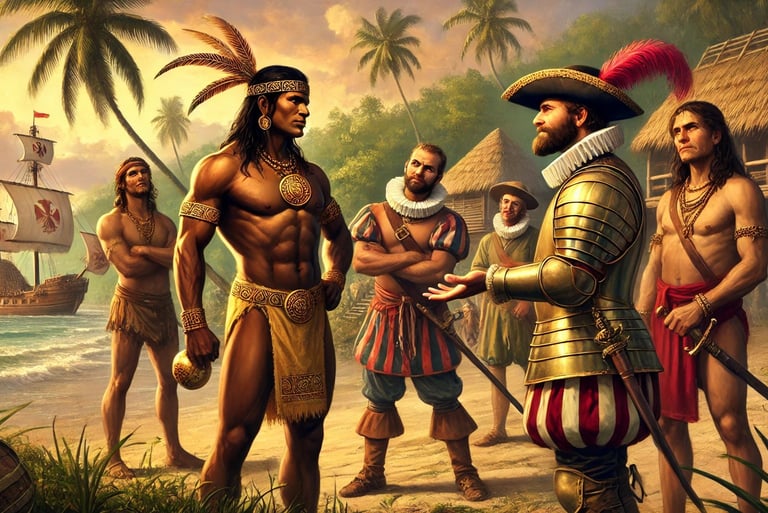
When Spain colonized Puerto Rico under Juan Ponce de León in 1508, the island became deeply intertwined with Spanish governance, religion, language, and cultural structure. Over four centuries of Spanish rule:
Spanish became the native language
Spanish surnames became the norm (Rodríguez, Rivera, Santiago, López, Ortiz, etc.)
The Siete Partidas, Spanish legal code, shaped early laws
Catholic fiestas and saints dominated the cultural calendar
Spanish agricultural systems (haciendas, encomiendas) defined the economy
By the time the U.S. took the island in 1898 after the Spanish–American War, Puerto Rico had already developed a distinct Hispanic identity rooted in Iberian influence blended with Taíno and African elements.
THE GENETIC RECORD BACKS ALL THIS UP
Multiple genetic studies, including those by the University of Puerto Rico, Cornell, and Harvard, consistently show:
European ancestry (primarily Spanish): 55%–70%
West African ancestry: ~20%–35%
Indigenous Taíno ancestry: ~8%–15%
This means the majority of Puerto Ricans carry Spanish ancestry — not because of some fantasy or wishful thinking, but because four centuries of Iberian colonization intermingled deeply into the population.
Anyone who’s taken a DNA test knows the result: Your chart lights up with Spain like a Christmas tree.
IF WE WERE TRULY “LATIN,” THE HISTORY WOULD LOOK DIFFERENT
If Puerto Ricans were historically “Latin,” we would see evidence of:
Roman influence in language (beyond what Spanish already inherited)
Roman legal systems directly shaping island governance
French or Italian colonial control
Latin-speaking (Classical Latin) ancestors or institutions
Cultural traditions directly derived from Ancient Rome
None of this exists in Puerto Rican history. Not one bit.
What does exist?
400 years of Spanish rule
Spanish grammar, phonetics, idioms, and dialect shaping Puerto Rican Spanish
Spanish architectural styles (plazas, cathedral-centered towns, fortresses like El Morro and San Cristóbal)
Spanish food influences (sofrito, arroz con gandules, adobo, pasteles with Iberian seasoning roots)
Even the music — bomba, plena, décima jibara — merges African rhythms with Spanish lyrical structure and string instrumentation.
THE MYTH OF A PAN-LATIN IDENTITY
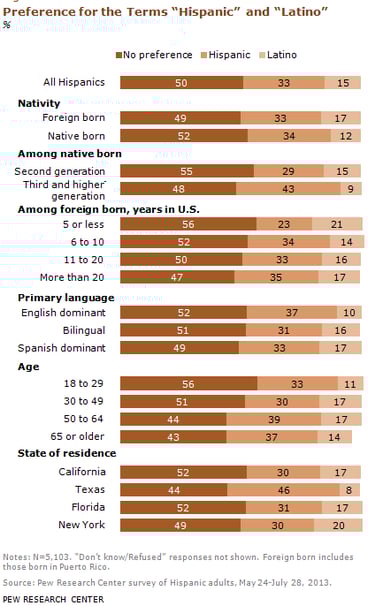
The term “Latino” in the U.S. became popular only in the 1970s, pushed largely by:
Activist movements in California and the Southwest
Communities with heavy Mexican and Chicano influence
Academic institutions trying to merge Spanish- and Portuguese-speaking groups into one demographic category
Puerto Ricans got lumped into it — not because it fit, but because policymakers wanted a simplified category.
And every time a Puerto Rican checks the “Latino” box, we participate in our own historical erasure.
THE SUPPLANTATION PROBLEM
Identity that isn’t rooted becomes identity that is overwritten. When Puerto Ricans casually adopt “Latino” as our primary descriptor, several things happen:
Our Hispanic identity becomes obscured
Our Spanish heritage becomes politically inconvenient to acknowledge
Our unique Caribbean cultural blend gets merged into a generic “Latin” category
Our history becomes flattened into someone else’s narrative
Our distinct African + Taíno + Spanish mixture gets painted over with a broad brush
Meanwhile, every legal, governmental, and formal institution STILL labels us as:
Hispanic.
From the FBI to the Census, from healthcare to housing applications, from employment to educational data — “Hispanic” is the governing term and the box I check.
THE TRUTH ABOUT CULTURAL CONTINUITY
We can honor our Taíno and African ancestors — that’s part of our soul — but we must also be honest:
We speak Spanish, not Arawakan Taíno.
Our cookware, spices, and stews reflect Iberian techniques fused with African roots, not pre-Columbian methods.
Our architecture follows Spanish colonial urban design.
Our surnames, documentation systems, and legal traditions come from Spain.
Our Catholic syncretisms are Iberian in structure.
You can’t erase 400 years of Spanish influence just because the modern world is uncomfortable with colonial history.
SO, with that stated, WHAT SHOULD BORICUAS CALL THEMSELVES?
Three words:
BORICUA — our inherited island identity
PUERTO RICAN — our national and cultural identity
HISPANIC — our linguistic and historical identity tied to Spain
Everything else is political, or externally imposed.
A CALL TO ACTION
Puerto Ricans don’t need the “Latino” label to feel connected to the wider Spanish-speaking world. We already are part of that world — historically, linguistically, genetically, culturally. But we do NOT need to dissolve ourselves into a category invented by French imperialism, U.S. government demographic strategies, and recent political trends. We have our own name. Our own culture. Our own lineage. Our own history. And it deserves to stand on its own — loudly.
*sidenote: the term "spic". . .
The slur spic is a derogatory term used in the United States to demean people of Latin American and Hispanic background, especially those perceived as Spanish-speaking. It has never had a neutral or respectful use. From its earliest appearances in print, it functioned as a label meant to reduce an entire group of people to “foreignness,” accent, and presumed inferiority.
According to linguistic research summarized by WordOrigins.org, the term emerged around the period following the Spanish-American War of 1898, when the United States took control of Puerto Rico and increased its contact with Spanish-speaking populations. Early forms such as spiggoty and spickety appeared in newspapers at the turn of the 20th century. These longer forms were soon shortened into spik and then spic, which became common slang by the early 1900s.
The most widely accepted explanation for its origin is that it came from mocking the speech of non-native English speakers. English speakers caricatured phrases like “no speak English” as “no spik English,” turning that mispronunciation into a label for the people themselves. In other words, the word was born from ridicule—specifically, from making a joke out of how immigrants spoke. Popular claims that the term is an acronym, such as “Spanish-speaking person in custody,” are false and rejected by linguists.
What makes the word harmful is not just its sound, but its purpose. It was designed to flatten people into a stereotype: the “outsider,” the “broken English” speaker, the one who does not belong. Like other racial slurs, it became a linguistic tool for exclusion, reinforcing social hierarchies and justifying disrespect and discrimination. Its history is inseparable from power dynamics, colonial attitudes, and the treatment of Hispanic people as second-class. Understanding this history matters because it clarifies what slurs actually do. They are not casual descriptors; they are weapons shaped by context.
That same logic extends across communities. If we recognize why a word like spic is unacceptable—because it carries generations of ridicule and harm—then it becomes easier to see why borrowing or normalizing other groups’ slurs is also a form of ignorance. Respect begins with recognizing that words carry histories, and those histories deserve to be honored, not repeated.
The slur spic is a derogatory term used in the United States to demean people of Latin American and Hispanic background, especially those perceived as Spanish-speaking. It has never had a neutral or respectful use. From its earliest appearances in print, it functioned as a label meant to reduce an entire group of people to “foreignness,” accent, and presumed inferiority.
According to linguistic research summarized by WordOrigins.org, the term emerged around the period following the Spanish-American War of 1898, when the United States took control of Puerto Rico and increased its contact with Spanish-speaking populations. Early forms such as spiggoty and spickety appeared in newspapers at the turn of the 20th century. These longer forms were soon shortened into spik and then spic, which became common slang by the early 1900s.
The most widely accepted explanation for its origin is that it came from mocking the speech of non-native English speakers. English speakers caricatured phrases like “no speak English” as “no spik English,” turning that mispronunciation into a label for the people themselves. In other words, the word was born from ridicule—specifically, from making a joke out of how immigrants spoke. Popular claims that the term is an acronym, such as “Spanish-speaking person in custody,” are false and rejected by linguists.
What makes the word harmful is not just its sound, but its purpose. It was designed to flatten people into a stereotype: the “outsider,” the “broken English” speaker, the one who does not belong. Like other racial slurs, it became a linguistic tool for exclusion, reinforcing social hierarchies and justifying disrespect and discrimination. Its history is inseparable from power dynamics, colonial attitudes, and the treatment of Hispanic people as second-class.
Understanding this history matters because it clarifies what slurs actually do. They are not casual descriptors; they are weapons shaped by context. That same logic extends across communities. If we recognize why a word like spic is unacceptable—because it carries generations of ridicule and harm—then it becomes easier to see why borrowing or normalizing other groups’ slurs is also a form of ignorance. Respect begins with recognizing that words carry histories, and those histories deserve to be honored, not repeated.


THE FOLLOWING BLOG ARTICLES ARE PUBLISHED ON EXTERNAL SITES - IMAGERY BELOW LEADS TO MY OTHER WEBSITES
UPGRADE YOUR PUERTO RICAN HOLIDAY MENU BY RETIRING OUTDATED SLAVE FOOD
ISLAND PRIDE -VS- NUYORICAN REALITIES
AN ATTEMPT TO DECIPHER MY PUERTO RICAN DNA
A WATERED-DOWN BLOODLINE - ETHNIC CULLING AND GENOCIDE


ANOTHER LOSING BATTLE: CANCER DISPARITIES AMONG WOMEN OF COLOR, PRIMARILY BORICUAS
LOST TRADITIONS


ABOUT VOODOO'S LITTLE SISTER, SANTERIA